

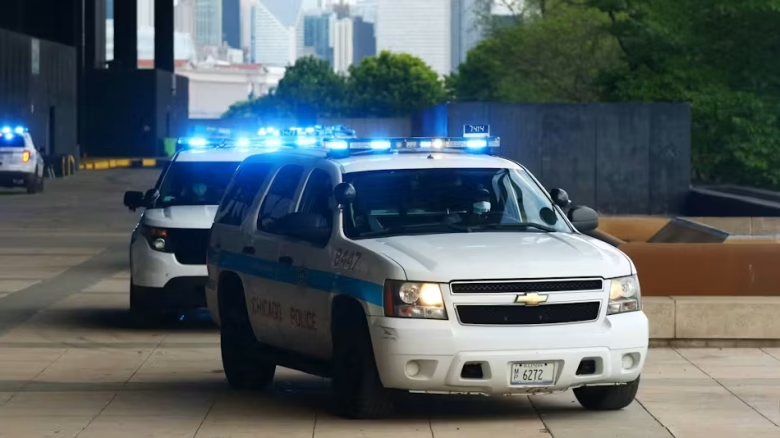
Chicago’s ‘gun crackdown’ targets people seeking safety
When Detaureo Harrington saw flashing police lights signaling him to pull over, he wasn’t worried about being arrested. After being arrested the year before in June 2022 on a gun possession charge, Harrington became an expert on gun laws. He knew the officer would want to inspect the firearm he carried in his car. No problem – it was safely stored in the trunk, inaccessible and unloaded in accordance with Illinois state law.
“I did so much research,” Harrington said, “there wouldn’t be anything I didn’t know before being pulled over with a firearm.”
Then the officer started reading him his rights. For the second time in just over a year he was being arrested for gun possession. For the second time, he had not violated a single gun law.
“I felt like justice didn’t really matter,” Harrington said. He was taken to the 12th District police station while one of the arresting officers drove off with his car. By the time he was released, his phone had died and his family had no idea where he was. He walked to the impound lot where his car was parked to find it wouldn’t start.
It was only the beginning of his troubles.
The invisible burden of false arrests
A judge quickly found that Harrington was in accordance with gun laws, so he was not charged with a crime. Still, the firearm arrests remained on his record without his knowledge–in Illinois, arrests that don’t lead to convictions are visible unless an individual goes through the process of having records sealed or expunged.
Harrington didn’t know this before he decided to search for new work. He sent out dozens of applications with no response. It wasn’t until he applied to work as a Lyft driver that he saw a flag on his background check and realized potential employers could see two firearm related arrests attached to his name.
“I didn’t even know that happens,” he said. Harrington has now been trying to find work for a year and a half. “This has ruined so many parts of my life. I’ve been on a downhill slope trying to fight back ever since that has happened.
A pattern of racial profiling
Harrington’s arrests followed an all-too-familiar pattern of CPS racially profiling Black and Brown motorists while searching for firearms. Each year, hundreds of thousands of traffic stops are performed by officers determined to make gun possession arrests.
Critics point out the practice of routine racial profiling not only fails to reduce violence and turn up illegal firearms, but also harms communities most afflicted by gun violence.
“They are taking guns away,” said Naomi Johnson, co-executive director of the Chicago Appleseed Center for Fair Courts, “but also incarcerating people and continuing cycles of poverty, disconnection and disinvestment in communities.”
The rising trend of gun possession arrests
Illinois has some of the most restrictive gun laws in the U.S. It is one of only two states that require a license, known as a Firearm Owner’s Identification (FOID) card, to own a firearm. State law also requires a Conceal Carry License (CCL) when transporting a firearm unless it is stored in a manner that limits immediate access.
Legislation of the past 25 years has significantly expanded the reach of gun regulations in Illinois, introducing new types of possession offenses and making existing charges more punitive.
In 2023, Illinois passed a state law banning the possession of assault weapons. Some of the law’s most outspoken opponents were law enforcement officers, including Illinois sheriffs who pledged to ignore the law and protect assault weapon ownership.
But CPD officers are far less protective of Black Illinoisians’ right to bear arms: firearm regulations have led to a steep increase in gun possession arrests that has disproportionately affected Chicago’s Black and Brown communities.
According to CPD data over 47,500 people have been arrested for common firearm possession charges since 2014, the earliest year for which data is available. About 38,900 of these, or 81%, were arrests of Black individuals.
While gun possession arrests have shown a clear upward trend over this 10 year period, overall arrests in Chicago have plummeted, falling from about 92,900 in 2014 to just over 47,200 in 2024. In recent years, Black arrests for gun possession alone have accounted for as much as 14% of overall arrests in the city of Chicago.
Overpolicing doesn’t prevent violence
This crackdown on gun possession has not produced a clear benefit to public safety. A CBS tracker shows that in 2021, the year with the highest number of gun possession arrests to that point, there were also the most gun violence incidents in Chicago over the previous decade.
A 2022 report by the Illinois Sentencing Policy Advisory Council also noted that sentence enhancements for gun crimes between 2010 and 2021 had “no measurable impact” on the frequency of gun crimes after each enhancement while prison populations grew over that same period.
According to Sharlyn Grace, a senior policy advisor with the Law Office of the Cook County Public Defender, a focus on non-violent gun possession offenses is not necessarily effective at targeting crime.
“It’s just easier to find and prosecute people for gun possession than it is to find and prosecute people for using a weapon to hurt someone,” Grace said. “Those may not be the same people, but if there’s a conversation about gun violence it’s in some ways low hanging fruit to target people who are themselves often victims and survivors of gun violence.”
The new stop-and-frisk
Ira Davis, a 41 year old Chatham resident, was confused when a CPD officer asked him for his CCL after being pulled over for an illegal u-turn. While officers can check a statewide database, called LEADs, to see if a license plate is connected to a FOID card holder, Davis said he was not the registered owner of the vehicle he was driving at the time.
“I don’t understand the point of him even asking [about a concealed carry license],” Davis said. “What made you ask that and assume?”
Davis, who does have a CCL, was brought into the Fifth District police station due to a database error. He spent five hours in jail before being released.
Johnson was not surprised that a police stop under the pretext of a traffic violation led to an unjustified arrest.
“You see that so often the pretext is thin to nothing – taillight out, failed to signal,” he said. “These are also things that are simply a police officer’s word against an accused person’s word in a court of law, so there’s a lot of room for these to be abused.”
While reported numbers of traffic stops, which are mandated as part of the Illinois Traffic Stop Study, have been falling in recent years, a 2024 investigation suggested the data provided by CPD significantly undercounts the number of traffic stops conducted to artificially inflate the rates of weapon seizures reported.
Illinois Traffic Stop data from 2024, for example, reports only 399 instances of weapons being found in traffic stops by the CPD. TCR analysis of arrest records from that year, however, found 1,402 instances of gun possession charges that also cite traffic violations, suggesting the arrest began with a traffic stop. Eighty percent of these arrests were of Black individuals.
A matter of life and death
In Chicago neighborhoods experiencing higher rates of violence – disproportionately Black and Brown communities – traffic stops carry serious risks for people carrying guns for protection.
In a 2018 Urban Institute survey of predominantly young Black men from Chicago’s West and South Sides, 93 percent of respondents said they carried guns for personal protection, and over a third said they had been shot or shot at recently.
“I cannot tell you the number of times that somebody has told me, ‘I have to have this for protection, I do not have a choice,’” said Margaret Armalas, a Cook County public defender. Gun possession arrests now make up more than half of her caseload, often for people trying to follow the law.
Financial and legal barriers keep some from getting licenses, leaving many to carry illegally out of necessity. Obtaining a Concealed Carry License, which requires application fees and trainings, can cost hundreds of dollars, and age restrictions bar individuals under 21 from obtaining a gun.
“It’s not that the charges people face are for violence or harm to someone else, but really just for possession of an illicit substance or item,” said Johnson, a report author.
As drug laws have relaxed, gun possession charges have stepped in as a new form of criminalization in these communities. “We’re really seeing the criminalization of gun possession as a replacement for the criminalization of drug possession,” Johnson added.
A new approach through violence reduction
The legacy of the war on drugs may also provide insight on ways to help, rather than punish, those most impacted by gun violence.
One advocacy organization, Stick Talks, promotes a harm reduction approach that borrows from the language of public health initiatives directed at drug abuse. This framework acknowledges that, for many young people in Chicago, the risks of carrying a firearm illegally outweigh the dangers of street violence.
In their workshops Stick Talk guides young people on how to safely interact with guns, teaching them responsible ways to store weapons and how to respond to law enforcement.
In doing so, the program aims to not only reduce the potential for negative police interactions, but also address the root causes of gun violence where policymakers have failed.
“We’ve seen that with the war on drugs, that harm reduction was critical to saving people’s lives,” said Johnson. “I believe that the solution to the war on guns is going to be cut from the same cloth.”
Your blog is a testament to your expertise and dedication to your craft. I’m constantly impressed by the depth of your knowledge and the clarity of your explanations. Keep up the amazing work!
THE 1704 SOUTH CAROLINA SLAVE CATCHER LAWS ARE STILL IN EFFECT! WHITE PEOPLE ARE THE LARGEST GROUP OF ILLEGAL IMMIGRANTS AND CRIMINALS ON THE PLANET.