

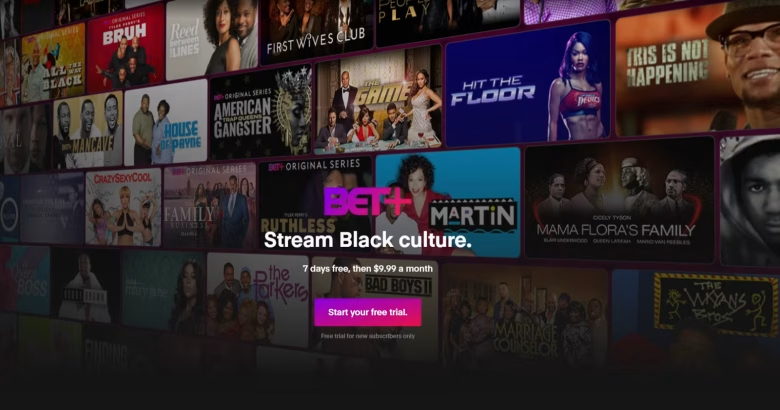
The dismantling of BET+ and what It means when Black America loses control of its own story
Last Friday, Paramount confirmed what many of us feared was coming: BET+, the standalone streaming service that was supposed to be a digital home for Black storytelling, is being shuttered. Its content will be absorbed into Paramount+ beginning in June. And in a move that carries perhaps even deeper symbolic weight, Paramount bought out Tyler Perry’s 25% ownership stake in the platform, the last remaining thread of Black equity in the BET ecosystem.
Let me be direct about what this means. The media brand that Robert L. Johnson built from a $15,000 loan in 1979, a brand that became the first Black-controlled company listed on the New York Stock Exchange, a brand that reached 70 million households and became shorthand for Black cultural visibility in America now sits entirely inside a corporate structure controlled by David Ellison, the Silicon Valley heir whose father, Oracle co-founder Larry Ellison, ranks among the wealthiest people on earth and has cultivated an increasingly close relationship with President Donald Trump.
The corporate language is, as always, reassuring. BET president Louis Carr wrote in a staff memo that BET’s “celebrated Black storytelling” will be “prominently featured and easy to find” within a BET Hub on Paramount+. That BET remains “a cornerstone of Black culture” and an “essential part of Paramount’s portfolio.”
I have been in enough boardrooms, written and read enough corporate memos to know the difference between what companies say and what companies do. And what Paramount is doing is consolidating Black media into a subsidiary tab on a platform whose editorial and business priorities are being shaped by forces that have nothing to do with the communities BET was created to serve.
This Is Not Just About Streaming Economics
The industry narrative frames this as routine platform consolidation, the same logic that folded Showtime into Paramount+ and that may eventually merge Paramount+ with HBO Max if the Warner Bros. Discovery acquisition goes through. And yes, every major media company is rationalizing its streaming portfolio right now. That is real.
But context matters. When Robert Johnson sold BET to Viacom in 2001 for $3 billion, Radio One founder Cathy Hughes captured the tension perfectly: it was a great day for Johnson, she said, but a significant loss for African American ownership. She was right. And in the quarter century since, that loss has only deepened.
The Federal Communications Commission’s own data tells a devastating story. While African Americans, Latinos, Asian Americans, and Native Americans make up more than a third of the U.S. population, they own roughly 4% of commercial broadcast stations. Women, who are 51% of the population, own less than 6%. The Telecommunications Act of 1996 was supposed to encourage competition and diversity. Instead, it opened the floodgates for consolidation that has systematically driven minority owners out of the market. Today, a handful of corporations – six, by most counts – control approximately 90% of American media.
Tyler Perry’s stake in BET+ was the last direct ownership link between Black capital and the BET brand. That connection is now severed. Perry will continue producing content for BET, but producing content for a platform and owning a piece of that platform are fundamentally different things. One is labor. The other is power.
The Ellison Question
David Ellison’s political biography reads like a weather vane. In 2024, he donated nearly $1 million to President Biden’s reelection campaign, telling interviewers he was “a socially liberal person.” By mid-2025, he was sitting ringside with Donald Trump at UFC fights. After acquiring Paramount through Skydance’s $8 billion merger, he settled Trump’s $10 billion lawsuit against CBS for $16 million, eliminated DEI policies at the network, purchased the conservative outlet The Free Press for $150 million, and installed its founder Bari Weiss as editor-in-chief of CBS News, a journalist with no broadcast experience who reports directly to Ellison, not to the CBS News president.
The consequences arrived swiftly. In December, Weiss pulled a completed 60 Minutes investigation into alleged torture at El Salvador’s CECOT prison, a facility receiving deportees from the Trump administration hours before it was set to air. Correspondent Sharyn Alfonsi called it a “political” decision, not an editorial one. CBS producers have resigned, citing a climate of self-censorship. Former staffers have alleged that layoffs under the new regime disproportionately targeted racial minorities and women.
This is the same corporate structure that now controls BET. This is the same leadership that will decide which Black stories get told, how they get told, and whether they get told at all.
Why This Matters Beyond Entertainment
At The Chicago Reporter, we cover the systems that shape the lives of marginalized people in this city and this country—the legal justice system, housing, education, health, environmental justice. Every one of those beats depends on a media ecosystem diverse enough to surface the stories that dominant institutions would prefer to keep hidden. When fewer and fewer people control the platforms where Americans get their information, the range of stories that reach public consciousness narrows. And it narrows in predictable ways.
Research consistently shows that ownership shapes content. The Leadership Conference on Civil and Human Rights has documented how concentrated media ownership correlates with stereotypical or absent coverage of communities of color—coverage that then influences hiring practices, courtroom outcomes, medical treatment, and policing. Free Press, the media advocacy organization, has argued that the lack of diverse media ownership is not incidental to racial injustice in America but structural to it.
BET, for all its imperfections and the legitimate criticisms it has received over the years about its programming choices, represented something essential: a nationally distributed platform where Black audiences could see themselves reflected, where Black creators could find a home, and where Black narratives could reach scale. Moving that content into a “hub” on Paramount+, a platform whose leadership is actively courting political favor with an administration that has made dismantling DEI a policy priority, is not expansion. It is absorption. And history teaches us that absorption and erasure are often separated by nothing more than time.
The Broader Landscape Is Alarming
What is happening to BET is not happening in isolation. Paramount, under Ellison, has laid off approximately 2,000 employees, roughly 10% of its workforce, including senior BET executives like Rose Catherine Pinkney, the senior vice president of scripted programming and development. The company is simultaneously pursuing a hostile takeover of Warner Bros. Discovery, which owns CNN, with Ellison’s allies privately arguing that he is the only buyer who can secure Trump administration regulatory approval. Democratic senators have demanded that Ellison preserve records related to any communications with the White House about the deal.
Larry Ellison, David’s father, has pledged over $40 billion to finance the Warner Bros. acquisition. Trump has publicly stated that the Ellisons are “friends” and “big supporters” and that he trusts them to “make the right decisions.” If this deal goes through, a single family with deep ties to the sitting president would control CBS, BET, Paramount Pictures, Showtime, and potentially CNN and HBO.
As Warner Bros. Discovery CEO David Zaslav pointedly observed at a gala in front of Ellison himself: “When the government controls the news, that is the end of democracy.” He was ostensibly talking about Poland. Everyone in the room knew he was talking about something closer to home.
What We Must Do
I do not write this commentary to be alarmist. I write it because The Chicago Reporter has spent more than five decades doing the work that the consolidation of media threatens to eliminate: independent, investigative journalism centered on racial justice and accountability. We know, from our own reporting, that the stories most vital to marginalized communities are often the ones that corporate media finds least profitable to tell.
Our newsletter open rates indicate that our communities are hungry for journalism that reflects their realities. Our investigative work on the legal justice system, on IDOC and Cook County Jail conditions, on environmental justice in Chicago’s neighborhoods—this work matters precisely because it exists outside the gravitational pull of corporate consolidation.
The loss of BET+ as an independent platform is a loss for Black media sovereignty. But it should also serve as a call to action. We need to invest in and sustain independent media outlets. We need to subscribe, donate, amplify. We need to demand that the FCC take seriously its obligation to promote ownership diversity, an obligation it has neglected for decades. We need to pay attention to who owns the platforms that shape what we see, hear, and believe about ourselves and our country.
Robert Johnson built BET from two hours of Friday night programming into a cultural institution. Tyler Perry poured his creative vision and his capital into BET+ to keep some piece of that legacy in Black hands. That piece is now gone.
The question before us is not whether Paramount will continue to air Black content. Of course it will. Black culture is too profitable to abandon. The question is who decides what that content looks like, who it serves, and what truths it is allowed to tell. When the answer to that question is a billionaire tech heir currying favor with a presidential administration that views diversity as a threat, we should all be paying very close attention. It is BET today. Who will it be tomorrow?
At The Chicago Reporter, we will keep telling the stories that matter. We will keep telling the stories that consolidated corporate media will not prioritize. That is what independent, community-centered journalism is for. And right now, it has never been more necessary.