This content was originally published on the Uptown Exchange, and is made possible through TCR’s partnership with Harry S. Truman College
A young woman came down the escalator, a posse of classmates behind her, and went right up to the Harold Washington College security guards with a question: Was her teacher coming to class, or could she and her mates go home? Nobody had an answer.
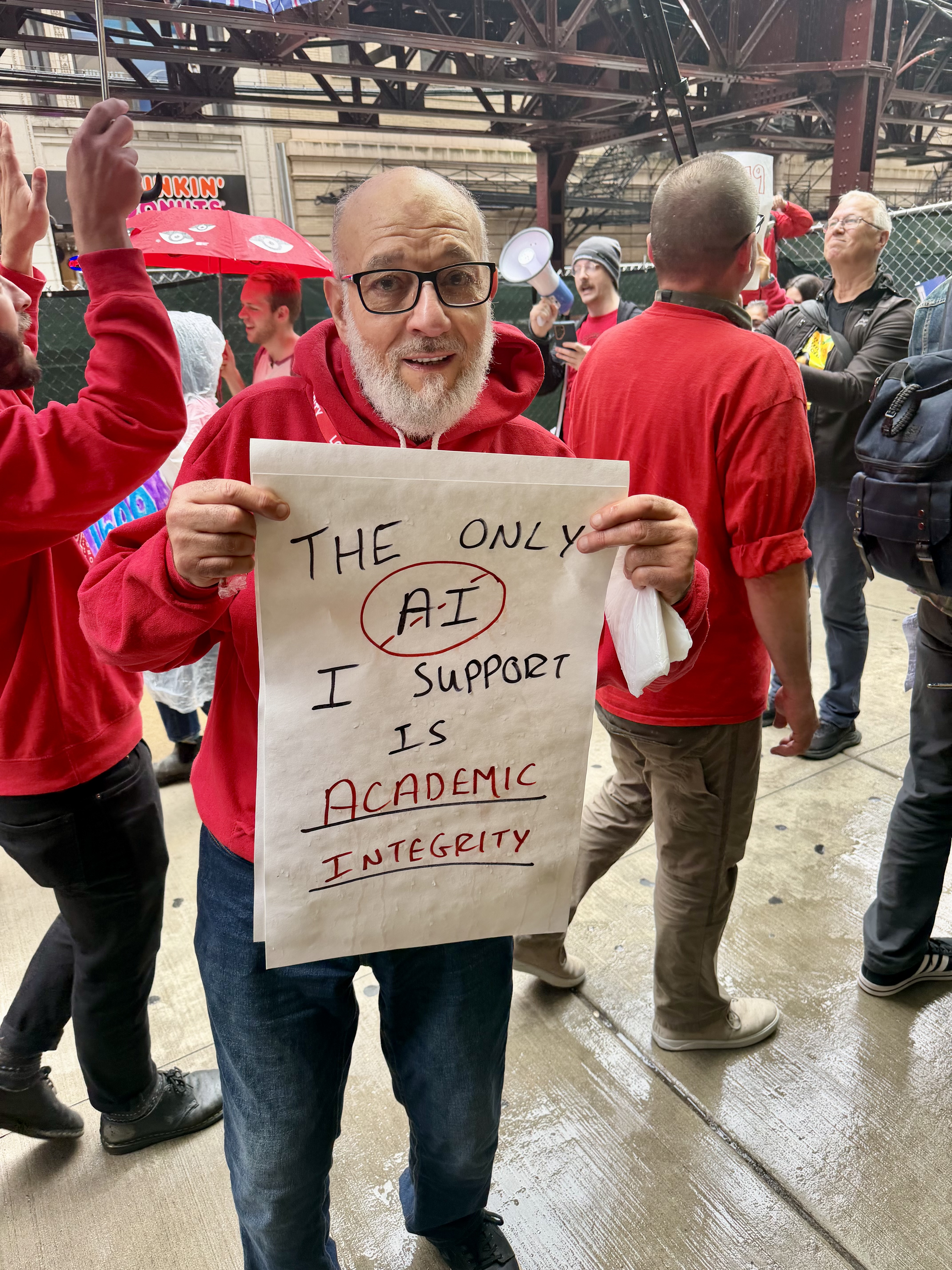
Rallying outside of the Oct. 1 City Colleges of Chicago Board Meeting, Local 1600 CCCTU President Tony Johnston announced full-time faculty and professional staff will strike on Monday, Oct. 19, unless a full contract is signed before then.
Ninety-six percent of Local 1600 members voted to authorize a strike; the contracts expired July 15, and talks have been open since February.
Out of 39 community college districts covering 48 colleges in Illinois, only one, City Colleges of Chicago, has a board of trustees appointed by the mayor.
Illinois lawmakers have filed bills to make the City Colleges board elected at least three times since 2016. None passed, and the most recent died when the legislative session ended in January 2025.
Advertisement
Outside the Board meeting, union supporters marched with signs that read:
“Chop from the top”
“Will strike for students”
“Humans not computers”
“#FairContractsNow”
Marcus Paulson, a full-time EMS lab coordinator at Malcolm X College for three years, led 95 people, by The Uptown Exchange’s count, outside Harold Washington’s side entrance, away from the State Street entrance.
Paulson got the group going with chants into a megaphone handed to him by organizers wearing red Party for Socialism and Liberation T-shirts, saying that the union was fighting for faculty so they could fight for students.
“Funds for education, not wars and deportation,” Paulson continued over bucket-drumming and the sounds of vuvuzelas — the plastic horns that create a loud buzzing sound, often associated with international soccer matches.
Board Student Trustee Damian Wright opened by saying he was not there to support any decision between either party and that his main concern was communication between students and the school.
“Half these students do not know what’s going on. Half these students aren’t even aware,” Wright said, worrying that many are going to come to school unprepared if a strike happens. “If you can’t even communicate with the students what’s going on, there is a very high likelihood that some of these students will not come back.”
Tony Johnston said he appreciated Wright’s concern in his opening remarks: “And we commit to reaching out to students so that their questions are answered.”
Johnston added, “We have been at the bargaining table since February, our contracts expired on July 15,” claiming that administrative staff had grown 88 percent over the past decade while seeing a fall in the number of full-time employees.
Johnston said to the cheering crowd, “This is not a budget problem. It is a question of priorities.”
Calvin Willis, a criminal justice student at Olive-Harvey, said he, too, was unaware of the potential strike, thanking his “fellow students for asking for transparency regarding the strike.”
Willis said, “There are some students who are struggling to get to class,” referring to the serious consequences a disruption in instruction could have. “I can’t imagine students making arrangements and exhausting resources to show up to an empty building with no staff.
“I want to make it clear,” Willis continued. “The students should not have to worry about whether we will be able to finish this semester, complete our classes or even graduate on time. We have invested our time, energy and resources into our education, and we deserve clarity about how academic progress will be protected if a strike occurs.
“I respectfully ask again that City Colleges and the Board of Trustees recognize the impact that this uncertainty has on us as students,” Willis said, before thanking the board for listening and “recognizing that decisions made during this time can have a lasting impact on our education and our futures.”